Showing posts with label ice dance. Show all posts

Monday, February 17, 2014

That Amazing Davis and White Lift

From their winning appearance in US Nationals 2014, this video shows the amazing lift D&W did for their Sheherezade performance.

Jaw dropping doesn't begin to describe it.

When I saw it at the Olympics (I was standing in the lobby of my ice rink, watching them on the world's crappiest TV without sound) I gasped.

Now, for your enjoyment, 11 seconds of the most amazing ice dance lift ever.


And since I don't follow women's singles, I'm done with the Olympics.

Saturday, July 6, 2013

Ice Dancing: The Bad Kind

You're skating on public, and you hear a catchy song on the speakers. It shakes you; It bakes you; You want to slither on the ice like a snake on the make.

Well, maybe not that last one.

So, I skate and get the rhythm of the beat.

I  Shake
I Bake.
Memories of my youth are expressed as movement:

My old dance coach is in a lesson with an eight year old. He sees me and he looks like this:


Then he yells after me, "When you start ice dance again?"

Someday!

Just not anytime soon.


Monday, December 31, 2012

The Ice Dance Industrial Test Process


People used to ice dance for fun, on dates, at all ages.

What happened?

The heyday of ice dance was between the 20's and the 50's. Rock and roll had a hand in killing it. The rhythms just were too popular to ignore and appealed to the younger crowd. The old dance standards died out and ice dancing became stuffy, and too hard, and the bar was raised too high.

And at one time ice dance was ragingly popular! So popular that, ice dance testing was introduced in the US (the earliest testing record is from 1928 in Canada, but the US dance test structure was adopted in 1939). You had to learn the pattern dances, and test them.

By 1941:
"...as dancers became test conscious, they did not want to spend time learning non- compulsory dances. With the focus on new dance  test requirements, the social dances that did not make the test schedule would gradually disappear...Serious skaters are goal oriented. They work on elements that offer a visible  measure of progress, such as a passed test, entry in competition, or the ability to skate a Silver level dance" (Figure Skating History: The Evolution of Dance on Ice) 

So in the fifties, when Rock and Roll took over the music world, young people must have looked at the  time and testing requirements for ice dance and abandoned the sport in droves. They wanted to ice dance for dates--who wants to spend months (years!) learning to ice dance when you can go out on the floor and dance right away! And who wanted to test to go on a date! It was too much commitment! Skating required commitment! The social aspects of ice dance were already beginning to die.

And now, 70 years after testing was introduced what do we have? We have the Ice Dance Industrial Test Process, where you test so you can take more tests.

And hardly any social dance sessions to dance on.

Or any male partners to dance with.


Friday, November 30, 2012

The Circle Dance--a Little Skating History

[So I've written about Fitness Skate and I've briefly mentioned how I'm working on some notation to help me 'debug' footwork for something like a Fitness Skate; today I wanted to give a little Ice Dance history as to how I came up with some of my ideas.]

A long time ago, before even I was born, ice rinks didn't come in standard sizes. They didn't even come in standard shapes. Some were open air rinks on ponds, other were indoors. In that era (the era of my 90 year old mother's childhood) many dances were circle dances. There were also dances in the shapes of 8s, and a couple of pattern dances as we know them today, but I want to focus on the circle dance.

In the circle dance, when the music began, the skaters started wherever they were on the ice and fit the dance in. The idea of a modern pattern dance, where the skater is at a particular reference point, with a particular step, was unknown. In social dance skating on the beat was not a priority. Rinks were so crowded that people skated where they could, maneuvering around other skaters by holding a step or adding extra steps to avoid traffic, until they could get back 'on the pattern'.
What ice dance may have been like before pattern dances
This struck me as an ideal way for beginner skaters to have something nice to do on the ice. It's just a circular series of steps to music without the obsessive fuss of 'OMG, you're not on the beat!' or 'OMG, your swingroll doesn't have enough extension!', or 'OMG, you don't have dance expression!' or 'OMG! I HAVE TO STOP THE DANCE BECAUSE THERE'S AN ICE TOURIST IN THE WAY!' or 'OMG! I don't have enough power to get in the corners!'

Sadly, these dances disappeared with the standardization of ice dances as pattern dances and the advent of ice dance testing on an industrial scale in the 40's. 

Testing in its own way is a fun challenge, but there's no reason there can't be 'fun dances' as well that could be done by couples or solo skaters on public. No pressure about precise placement of the steps relative to the rink, no worry about extension, or putting in an extra stroke to work around traffic, or worrying about some judge. They should be fun!

So I pulled out my copy of The History of Ice Dance, and started looking at some of the circle dance patterns to see what I could use. Two problems emerged:
  1. In the old days, people had skated figures for a while before taking up ice dance. They could do rockers, brackets, and counters, so many dances had these in them. I wanted to find some dances or footwork suitable for beginners on public. *cough, Me, cough*
  2. The diagrams often had notation that no longer made sense. Ye Gods! What's a "FIOB"? A 'forward inside outside bracket'?  And the drawings were so tiny or such poor resolution I couldn't always figure out the steps from the tracings.
What I took from the diagrams were three facts: since the dances were circular, it wasn't necessary to draw the tracings in a rink shape, the dance patterns instead were in a straight line. Secondly,  what I really wanted to do was to develop footwork that could be 'done' to music of any beat, really just footwork for the solo beginner, that might also be done by a pair hand in hand or killian position. Third, I wanted something simple enough for beginners like myself, or adults that want to do something on public for fitness that's easy enough to do, but more complex than just stroking around.

And whatever these steps/footwork are, they should be able to be skated to any rhythm (tango, 4/4 rock/pop music, or the rare waltz on public) without any need for obsessing about placement on the ice. Don't have enough power to do a pattern in a big circle, do it in a small circle.  Don't like the music? Don't worry about the beat!
I don't have to worry about fussy ice dance crap? Woohoo!
I asked around a little, and pretty much if I wanted some footwork or circle dances, I had to come up with them myself. That lead me to thinking about notation and how I'd show it or record it for myself.

So, that's where I am, working on notation and simple footwork ideas. I'll introduce the notation soon and show some footwork patterns / a dance and get some feed back from you.

Tomorrow is a funny post, see you then!

Thursday, September 13, 2012

Challenge Dance

I am ashamed.

I can't skate to the beat in ice dance.

Oh, I know the meter (waltz, tango, blues). I can hear the beat. I just can't skate to it. I'm always half a beat behind.

So, while I was at Lake Placid, I stumbled across a technique to help me out with my ice dance timing issues.

I skate a dance to the wrong song, in the wrong rhythm.

Yes, I'm a rebel. A wild child of ice dance. The hippy dippy skater.
Whoa, dude, like skate to the wrong music, like y'know, wow, man, like really, really wow.
(Yes, we did talk like this in the 60's)


I wanted to practice the Canasta Tango, but they were playing a waltz on freestyle. So I skated to it. You really have to concentrate when you're swapping stuff around. Then I did it to the Blues. Then other waltzes. I was getting better at getting on the beat, because I had to really, really think about what I was doing.

It's not hard to swap the steps for the preliminary dances to music it's not designed for. What steps are there? Swingrolls, progressives (crossovers), chasse's. Except for the step behinds in the Rhythm Blues, the dances are pretty interchangeable.  I asked the Amazing Coach about it for the upper level dances and she thought it might be possible with some small adjustments here and there.

Anyway, I demonstrated this with the Nasty as done to the music of the Dutch Waltz to some of the ice dancers who know my dread secret. I expected to get some critiques from them, but instead I got applause. Whether that was for my technique, or because I was finally on the beat I don't know. Considering my difficulty with the Nasty, it was a nice gesture.

Anyway, to all you ice dancers out there. How 'bout a round of Challenge Dance. Can you do the Dutch Waltz to a tango? Or the Rhythm Blues to a waltz beat?


PS: It absolutely drives Dance Coach crazy when I do stuff like this. He wants everything laid out, in order, with proper structure. 
We do dance the way dances are meant to be done!


Monday, March 5, 2012

Skating Apps for the iPhone

Here's my review of some figure skating Apps from the Apps Store.


USFSA Basic Skills

This app covers all the required skating skills in the USFSA Basic 1-8. There's a young child skater, who demonstrates the skills. There's not much to the App. You click through the levels and run the videos. I suppose it's designed so a parent can use it to motivate a child. However, I think using child demonstrators is not a good idea, because their small size can make it difficult to see the detail of what they're doing. Some slo-mo for clarity.

Does not include a written description of the skill and the passing standard.

USFSA Adult

This is effectively the same as the Basic Skills app, it's a collection of videos laid out in the structure of the Adult Basic Skills Program. This time the demonstrator is an adult. I think it's easier to see the details of the skating.

Does not include a written description of the skill and the passing standard.

USFSA Dance

This App is a little more complicated than the previous two. It has three sections: demonstrations of the skills for all 6 levels of the Dance program for USFSA, demonstrations of the preliminary and pre-bronze dances + images of the dance patterns, and music for the preliminary and pre-bronze dances. The demonstrator is an adult. All skills and DANCES are demonstrated solo.

As USFSA gets into areas that are a little more complicated than straight videos, their lack of attention to detail gets to be annoying.   For example, the patterns can't be read without enlarging them, but when you enlarge them there's resolution issues with the print. Unless you know the dances well, it's sometimes hard to make out the steps in the pattern. Sloppy. 

The dances are demonstrated solo. I've no objection to this, but I would have been willing to pay extra to see them partnered as well. Without a partner it's not dance, it's an edge class.

There's music for the first 6 dances included. This is a nice touch. Strangely, the dance music doesn't always match the music used in the demonstrations. Lack of attention to detail again.


iSkate Improvers

This appears to be an app produced by an Australian or British skating body. I don't swear to it though. It's level 6-10 of a complete skating program. Levels 1-5 are in iSkate Beginners.

This is a really nice app.  All moves are demonstrated by an adult, with an initial demo, followed by close ups of the feet and body, and slo-mo. Written tips for the skater are included with each video. You can also order a workbook. The only downside I feel is that the skater's face needed better lighting. Trivial, I know, but it was noticeable and I like to see head position for some moves. Still her skating was fine, and the use of a yellow vest made it easy to follow her arm movements if she passed in front of an overly dark or bright area of the rink.

Of the apps I've reviewed, this is by far the best. Even if you are in USFSA or ISI, you could use the tips and demonstrations in this app to support your skating. USFSA should hire this company to make their apps and do it right.

Friday, February 24, 2012

Style points in ice dance

One of the idiosyncrasies about skating is that when you take up serious skating--I'm not talking about competition, but about serious recreational skating--you'll find your relationship with your coach becomes an apprenticeship. No matter how many books you read, or videos you look at, there's stuff that never gets taught there. You have to learn it from a coach.

Ice dance is full of that. Let's call it 'style points'.

Style Points

First off, what's with all the ice dance hand holding? When I started, Dance Coach would extend his hand and I was supposed to take it and hold it while we skated around the rink. Where does this stuff come from? Is it part of the Ordo Sanctus Taberna? Yeah, I saw it in the Olympic warmups,  but never really thought about it until Dance Coach took me by the hand. And, I've seen other male dance coaches do it. Once I saw a dance coach in his 30s skating around hand in hand with a woman a lot older than me.  As near as I can figure it out, it's a way for the male coach to keep the lady in position while he gets ready to sweep her in position for the dance. Or maybe he wants to make sure she doesn't escape without paying the bill.

 I didn't like it when I started dance, and I don't like it now. It looks silly on public, because the public doesn't know what's going on. I sort of compromise by resting my hand on Dance Coach's arm instead of taking his hand.  However, sometimes it amuses me to imagine Dance Coach as a young skater getting an initiation into ice dance from an older male coach: "Take the lady's hand and skate around with her." the older coach says.  Dance Coach asks, "Even if she's old and wrinkly?" Older Coach, "Especially if she's old and wrinkly. They're the ones with money,"
-------------
After I had been doing ice dance for a while and was getting ready for my first test, Dance Coach taught me my presentation glide. This is the little 'bit' at the end of a test where the gentlemen presents the lady to the judges. This is pure style, and I've seen two ways; The legs in the shape of a 4 (the free foot at the heel of the skating foot), and the one with the free foot extended ahead of the skating foot.  Oh, the competitive skaters have little twirls and elaborate holds at the end, but I'm talking about recreational skaters.

I don't know if there's anything other than style points for this. Some coaches do it one way, other coaches do it another. I've asked other recreational ice dancers and there doesn't seem to be any rational reason for a preference. I'd like to know if one way is the Russian way and the other the American way, or if one way is for beginners and the other for silver and above. Just curious.
------------------
Now that I'm learning the Swing Dance I've learned the 'proper' entry into the hold.  One day I was waiting for him to step up to me, and he just stood there silently, making significant eyebrow twitches. So, I can take a hint, I stepped into the hold and he smiled. Now see here, I know this from my dog training days. You just ignore the behavior you don't want and give a reward when the dog does the behavior you do want. Maybe I'd learn faster if Dance Coach kept a pocket full of kibble.

Anyway,  the bit where I'm supposed to step into hold, must be a remnant of ballroom dancing.  The lady is supposed to be the weaker of the pairs, and the gentleman is supposed to sweep her off her feet. I'll do the step into hold as long as I don't have to swoon.
-------------------------------------------

What is a progressive?  It's not a crossover.  Unfortunately, the progressive (or run) is poorly defined by the ISU: "A step or sequence of steps in which the free foot passes the skating foot before it is placed on the ice, thereby bringing the new free foot off the ice trailing the new skating foot."  Someone has to teach you how to do this.  Unlike a crossover where you step over the foot,  instead you slide the free foot directly ahead of the skating foot. Then in a mystical miracle of ice, the old skating foot does an underpush and the free foot becomes the new skating foot. The operative word here is "smooth". With my old knees, it's harder than it looks. There's some technique I don't have yet.

Then I was reading Mer's blog Ice Pact. Her coach Dmitri Ilin says "that forward progressives are really just crossovers. Apparently everyone calls them crossovers except dancers, so there's your figure skating semantics lesson for the day."  Funnily enough, Dance Coach also says "progressives are crossovers but smoother." I don't think I'm going to take this as literal truth. I prefer to think it's something to tell beginners. Or maybe, here in the US, progressives just aren't that important.

Do you see many progressives in ice dance at the Olympics or the Grand Prix? I haven't. Maybe they're just reserved for test situations, and will become a style point that's only done by amateur skaters.  Although I understand that the UK dance coaches are strict about maintaining the correct form, progressives may eventually become a relic as the pattern dances fade away into a memory along with the circle dances.
-----------------------------------------------

So that summarizes some bits and pieces of ice dance style points that I've observed. I'm hardly authoritative, and if you want to chime in, have at it.

Sunday, February 12, 2012

Ice Dance is Good for Your Skating: Part 1

The more ice dances I learn, the more respect I give to the coaches and pros who developed not only the dances but the structure of the testing program. Since I'm a system engineer,  I started doing a matrix in my head of the skill building that comes out of ice dance. Then I decided to do an irregular series of posts on what I see are the skills coming out of learning the compulsory dances.

Dutch Waltz-Swing Rolls & Progressives (or Crossovers), Stroking
This is the dance where I felt the emphasis on edges really comes to the fore for a beginner skater. To do the swing rolls you must have confidence in your edges, and the fact that it's a swing roll rather than an edge, emphasizes the independence of the body from the motion of the free foot. At the end, there is a change in the rhythm of the progressive that gives the dance enough variety to keep the new skater alert and keep the dance from being robotic.
Skills: Edges, Independence of Body, Rhythm

Canasta Tango--Swing Rolls, Progressives (or Crossover), Cross Roll, Chasse', Slide Chasse'
There's no real stroking in this dance, but I've come to respect it for what it does for your stroking. Not only do you have some interesting footwork, but to make this dance 'go', I feel you need strong impulse on every single push. Since you're pushing into a different element every time, you have to lead the curves and anticipate how you need to hold your upper body for each new element. The slide chasse' prepared me for those future dance moves where I needed to hold my foot ahead of me and develop the skills not to rock back when I do hold the foot forward. The cross roll to swing roll on the end pattern has some quick changes in upper body required, and anticipation of the next edge.
Skills: Power, edges, anticipation of curve, getting used to the forward foot

Rhythm Blues--In the Canasta Tango the second curve of the dance was a mirror of the first curve. In the Rhythm Blues you have something different with every step with no mirroring. This dance really makes you work on your kneebend and your rhythm (coating of beats). Also, the swing roll on the inside edge is introduced. On the side pattern you have two progressive/crossovers. The first you rise up on the skating leg before you cross, the second you hold the under leg, well, under for two beats. No just sliding through a couple of progressives here. You have a pause before one, and a pause after the other. You now have to break up the rhythm of your stroking, hold and then move on at the right beat. The second of this series, the progressive with the 'hold under' is immediately followed by a step into a FI Swing roll. Although it's never explicitly stated, I think this beautifully prepares you for the wide step in the Cha-Cha.
As for the Evil Step Behinds? Remember the slide chasse' in the Canasta? That slide chasse' prepared you for the forward position leg in the step behinds. Elegant planning. And the step behind itself? Ah, that preps you for the little step up/step back down in the Cha Cha. It also got me over my fear of putting one foot behind the other.
Skills: Inside edges, varying steps, counting the beats, preparing for the Cha-Cha, knee bend.

I spend an hour today on a freestyle session. Every single coach was working with their student on spins or jumps. Not one student was working on any skating skills. Sad. I guess Ice Dance will remain the last bastion of good skating. Certainly the beautiful planning in the compulsory dances could be used by anyone to improve their skating skills. The more I learn; The more I admire.

Tuesday, January 24, 2012

What's Wrong with This Picture?

From Andy Riley's "The Bunny Suicides"

1. The woman's weight is not over her skating foot.
2. The gentleman has his knee in her back.
3. Her free foot has no extension and she's too deep in the knee.
4. She has way too much clothing on for it to be ice dance.

Friday, January 20, 2012

Me and My Ice Stalker

Several years ago (before the broken ankle), I was stalked on ice by some guy in hockey skates.

I occasionally skated at a rink with my friend the Big Guy. He's 13 years younger than I am, and I have been identified by waitresses as his mother. (I tell them he's my gigolo.) Anyway, it's pretty obvious we're not a couple.

So the Big Guy is in lesson, and I'm working on my back edges. Every time I set up a pattern, there's this guy in a funny hat standing in my line of pattern and staring goofily at me. So, I move to another part of the rink. It happens again.

And Again.

This has got to stop.

I switched to forward edges and set up a pattern. When he got in my way, I glared at him and snapped out my copyrighted "In a pattern here!" in my best, do.not.mess.with.me voice.

O....M....G

It was like feeding honey to bees. I skated around the ice, and he followed me at a distance.

I didn't feel threatened. For one thing, the Big Guy is 6'3"and he would laugh the guy off the ice. For another, I spent 30 years in the military. Even on skates I could handle a guy. (As an aside, back when I was young and good looking, I once put a guy on the floor of a bar when he copped a feel.)

But he's messing up my practice.

Finally, the Big Guy finishes his lesson and I tell him about my stalker. He and his coach stare at the guy.

"You could take him." The Big Guy says.

If this were to happen today, and I told Dance Coach about it, the first thing he would ask would be, "How were his edges? You need a partner."

Tuesday, December 13, 2011

Move.Smooth

"Don't jerk your foot like that." Dance Coach has the frowny face as he watches me do the Evil Step Behind from Rhythm Blues. If I'm not paying attention, when I  bring the front foot up, I do it too quickly (just to get the thing over with) and my upper body will rock slightly in response.

Ah, yes. Move. Smooth. It's more than just style points. There's actual physics involved.

Since I'm a beginner, up to this point, most of my skating problems have been soluble by thinking about my center of gravity.  It's not until I got to the Evil Step Behind that I run into more complicated concepts.

For those of you pursuing Freestyle, I'd better explain The Evil Step Behind. Think of it as a back cross roll, without the back, or the roll. You skate forward, bring the free foot in front, then gracefully (this is ice dance) move it so it crosses behind the skating foot, to the opposite side, and switch feet so the free foot is now the skating foot. You don't 'roll' so there's not any margin of error of skate placement. This is usually the make or break point for adult ice dancers. And it's in a beginner dance. Fortunately, Coach Amazing helped me past this point with her advice to Point.That.Toe. Now, I have to achieve consistency and 'pretty skating'.

What happens when you too quickly move your foot up ahead of you, either in the first step or subsequent steps? Well, there's a disturbance in the Force. And that disturbance is called jerk. I do not make these names up.

What happens when that front foot snaps up too quickly is that your foot accelerates up, then suddenly stops. The rate of change of acceleration abruptly goes from something to nothing. You get a physical jerk, hence the name.

When you stop that foot too quickly the rest of your body has to respond to the resulting release of force. A beginner skater like me wobbles in the upper body to keep from falling. This doesn't happen when you're standing on the ground, but when you're in skates, you're on the rocker. Your stability is lessened and the upper body is sensitive to sudden changes in acceleration. Even small changes in acceleration such as from a badly done step behind can cause a wobble in the upper body. (More experienced skaters don't have this problem, as they have better body control and years of practice. This is a beginner problem. )

The solution to this is to Move.Smooth. The motion of raising the foot from the ice and bringing it to a stop has to be done so that there's a slow change in acceleration. It should be like stopping a car when your elderly great grandmother is sitting beside you. Don't just 'step on the brake' to stop. Plan that stop so it feels like a soft pillow gently being put on a sofa. Same thing with the step behind. Raise it (increase the acceleration from zero to something), then bring it to a stop in a planned manner. Smoothly.

Interestingly, in the early rocket programs of the 50's and 60's jerk caused the destruction of many rockets. Here's some motivational video of rockets exploding.


Friday, December 2, 2011

The Du-uuu-uutch Waltz Countdown: 6 Days

So, you're thinking the Dutch Waltz is a dance of great antiquity, danced by dutch skaters down the canals of Holland. Sorry that's the Dutch Roll they did down the canals of Holland. The Dutch Waltz was invented in 1948 at the Broadmoor  Hotel in Colorado Springs, Colorado by the eminent coach George Mueller (who also invented the Fiesta Tango).

George Mueller and wife Leah


As I've discussed before the DW has Stroking, Progressives, Swingrolls. It's all forward movement. Practically anyone past Basic 5 should be able to do a version of it. So why isn't it introduced as a skating exercise in LTS? I mean wouldn't it be great to have a class skating around the rink to music and having a good time?

Yeah, I know why. It's that god awful music.

I have to test to "My Bonnie Sails over the Ocean." The music is so bad it makes my teeth hurt. So I understand why ISU has standard music for testing, but couldn't someone make the preliminary dances fun?

Certainly, all that's needed is some music that appeals to people rather than music that is designed for testing. There's waltzes in zydeco, C&W, R&B, even Rock. Joe Cocker did a waltz time version of "With a Little Help From My Friends" that's almost the right speed. Here's what the Dutch Waltz looks like to a zydeco waltz;

Dance, mon cajun dance!


So, why doesn't LTS introduce ice dance even in this minimal form? Even this simple dance teaches footwork, edges, timing, any rhythm. Oh, I forgot, LTS is all about building your skills to jump, silly me.

But still I think it would be a good idea for people to get exposed to this very simple dance in LTS. With the right music, it could be fun. I'm sorry the USFSA is all about jumps. Dance is where you learn to skate.

Friday, November 11, 2011

Someday I'll look back and laugh-ha ..... ha....

So because of my schedule and the distance to the rink, I'm only able to take lessons on public ice. Mind you, I'm doing a mix of moves and dance with the emphasis on ice dance. Ice dance, even the baby dances that are all facing forwards and designed 'for encouragement', take up the whole rink. Plus there are two people locked together in a dance hold moving swiftly (or in my case 'relatively swiftly') across the ice.

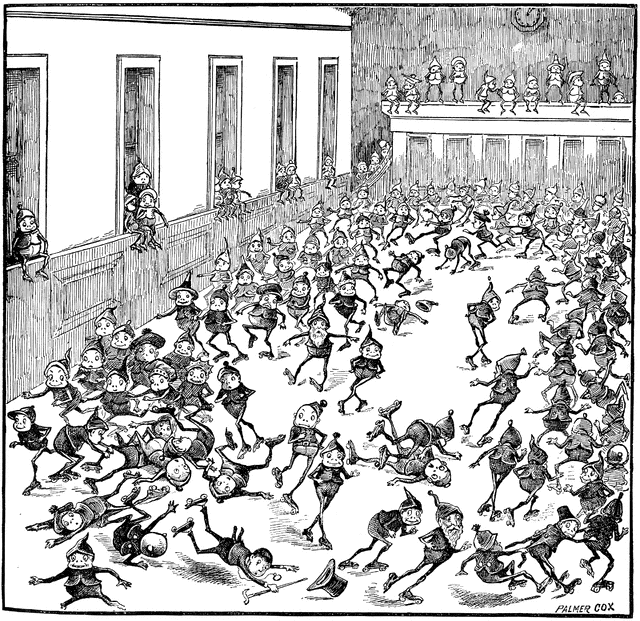
So here is what the rink looks like when it's a public session:


My coach and I are moving around in the Killian hold or reverse Killian hold, side by side like a wall moving through the skaters. 

One thing I've learned is that little kids have no sense of how fast we're moving; they don't look before they  move away from the boards; and they only are able to focus on what they want to do.

Shockingly the adults are exactly like them. So it's up to Dance Coach to give me cues on 'break', 'skate here', and 'stop'. He has the lead, and he has the years of experience. 

Still once a little girl turned unexpectedly into our path and stabbed me in the leg with a toe pick. 

As another example, Coach and I will be in the center doing crossovers in hold around the circle. To me it seems scary fast, but to Coach I'm sure it's just a breeze. Anyway, adults will skate right at us.  We're a big black clad train who will crush anyone in our path if they skate in our way and we can't stop.  We're careful but I'm shocked at the number of people who blunder into the center as if we're not there. How did these people get driver's licenses? How can they not see us?

So here's what I want to wear the next time I take a lesson on public ice.  

The only thing that's missing are the laser eyes