I was deeply affected by a group lesson given by a coach at Lake Placid when she started her mohawks class with a motivational speech. "Basics are critical." She said, "I'll get a student in who comes and says 'I'm having trouble with my flip.' Then she'll do this..." The coach stepped into an awkward forward crossover. "And I have to say to her, ' Whoooa! Maybe we should step back from that flip and work on your crossovers."
I don't want to be that student, so absorbed in some advanced element, that I don't realize that I don't have control of my basic elements. I suspect that coaches casually eying a skater look at those skating skills with a critical eye, and rate that student accordingly.
My GOAL for now is nailing my skating skills solid. No excuses. No spinning in the corner. No self absorbed pursuit of 'fun' in skating. I want to be a skilled skater. A REAL skater.
Coach Cruella and I started private lessons this week. I want to improve my skills, but as I'll post tomorrow, sometimes you have to go back to the beginning to fix bad habits and relearn stuff. So I took 10 minutes and created a 3x5 card with my skills on them divided into sections. I think this is a worthwhile exercise for anyone in any sport or long time endeavor. I gave it to Coach Cruella for her reference.
I divide my skating world into four divisions: Weak Skills, No Skills, Goal Skills, Improvement Skills.
Weak Skills
Mohawks -- I have the hoppy ones :-(
Back Edges--lack of power
FI3--can only do them from a stop
Back Cross CCW
FO3 at speed
Improvement Skills
Power
Crossovers--The Twinkle Toes Maneuver isn't consistent
Back Chasse'--Short, no power
Swingrolls -- Extension needs to be higher
Checking
No Skills
BO3
Choctaw
Goal Skills
Rocker
Counter
Bracket
I plan to lay out a chart to track all my skills from the most basic to the most complex so I can treat them like a process chart. Unfortunately, my experience with figure skating is most books are worthless, and the DVDs are jargon filled and require you to already know what they're talking about. Maybe if I can break each skill down into a chart, I can get a better mental grip on them. This Goal Card is just a start.
Sunday, April 1, 2012


Saturday, March 31, 2012
Hand in Hand Skating
I learned a new dance hold today. The gentleman skates behind the lady and holds her hands from behind.
It looks something like this (but holding both hands).
(UPDATE) You can imagine another rat skating behind this little girl rat (pink boots!) and holding her hands, skating in rhythm to the Rat Polka. Obviously, she's skating in Solo Dance here, working on her pre-Silver Rat Dance.
It looks something like this (but holding both hands).
 |
| Ukrainian Folk Dance Troupe |
I searched and I searched for a picture of this dance hold, and it appears to be peculiar to Ukraine. The Ukrainians are mad about dance. This explains the fact that you can't shake a tree at any large rink without shaking out a Ukrainian ice dancer. And it explains Sergei Polunin. But that's another story.
Anyway, we skated some fast stroking and crossovers in this hold. It's kind of fun--especially since the coach can't go any faster than you are. But, I swear I've never seen this in any video of any ice dance. Maybe it's a transitional step, but it seems so trivial.
"What dance is this from?" I asked.
"Oh, used to warm up, and is in a few dances." he replied. We did it again.
"What's it called? The hold I mean."
Dance Coach was stumped "I don't know in English. Maybe called hand-in-hand. In Russian is called Rat Polka."
My head snapped around to look at him. "The RAT POLKA?" I swear, I heard that.
He pronounced it again in Russian. Listening closely it sounds something like ras-poh-ka. But, I'm going to remember it as the Rat Polka Hold. With it's own teeny, tiny little band.
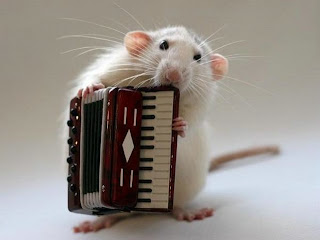 |
| Ratty Yankovic. Fresh from a tour with the Chmilewski Family Fun Time Band |
(UPDATE) You can imagine another rat skating behind this little girl rat (pink boots!) and holding her hands, skating in rhythm to the Rat Polka. Obviously, she's skating in Solo Dance here, working on her pre-Silver Rat Dance.
 |
| This artist has a number of paintings of rats skating KMCoriginals on eBay |
The rest of the lesson was spent in more traditional holds.
No rats were harmed in the production of this blog.
*Back in the 70's I used to live in Duluth, Minnesota. We had one TV channel. Every Monday after Snowmobile Corner (in the winter) or Fisherman's Corner (in the summer), the Chmilewshki Fun Time Hour (it was a 30 minute show--I thought this was deliberate Minnesota humor) would come on. The show was painful to watch--the band played up front while videos of people dancing was projected on the blue screen behind them. Great polka music though. Not only is this band still going strong, 5 generations of the family has been playing polka music for hire since 1882.
Thursday, March 29, 2012
The Okay Plateau
When learning a new skill there comes a point when you've mastered it.
Not.
Even chess grand masters, world champion skaters, and famous cricketers (hello UK visitors) never master their skills.
They're much, much better than the rest of us are, but no skill is ever 'mastered'. What the world champions, grand masters, etc. are is 'they're much, much better than the rest of us'.
So how do they get there?
What happens is 'the rest of us' (you and me), we get to a point where we're comfortable with a skill and we decide 'There, I've mastered that' and we move on.
This is called the Okay Plateau. As in, "I'm OK with that skill, I'll move on." Amateurs learn a skill and go on autopilot after that.
Big Mistake.
Getting a skill to an expert level requires challenging the skill in practice. If you just practice and are satisfied with the skill, then you probably will not reach expert skill levels. For example, chess grand masters spend enormous amounts of time on the basics, studying each move in the games of famous masters move by move. World champion skaters not only work on jumps but also skating skills. Amateurs spend their time on jumps and spins.
This is where deliberate practice comes in. In an earlier post I wrote about the concept of Achieving Failure. That's a two part concept. First, figure out how to do a skill in a way that you achieve an 'educational failure', a failure you can learn from. Sometimes it might mean doing something with more speed, other times odd entry angles, or different arm or body positions. It depends on the skill. Second, meticulously take apart that failure and fix it.
The problem is, in skating, fixing a skill is difficult for beginner skaters. We simply don't have the breadth of experience to analyze how to fix it. We rely on our coaches or group classes. Sometimes we can be overwhelmed by the sheer number of things we have to learn. Kids usually learn basic skills quickly. But it's the rare child who has the mental maturity to focus on practice and work on skills that aren't naturally easy.
As adults we can do what most kid skaters can't do, we can apply our mental maturity to getting past the OK Plateau. That means working to achieve an educational failure, then building the skills to fix that. Stroking along and doing things we're comfortable with won't hack it.
This means.....I have it in me to learn spins. And at least some half jumps. My age and my fears may stop me from going further, but there is no reason I can't learn single jumps with enough focus, time and fearlessness.
So those of you who are reading this, take heart. In theory, even if you didn't skate as a kid, even an axel is within your grasp! (with enough money, time, coaching, and good knees).
Not.
Even chess grand masters, world champion skaters, and famous cricketers (hello UK visitors) never master their skills.
They're much, much better than the rest of us are, but no skill is ever 'mastered'. What the world champions, grand masters, etc. are is 'they're much, much better than the rest of us'.
So how do they get there?
What happens is 'the rest of us' (you and me), we get to a point where we're comfortable with a skill and we decide 'There, I've mastered that' and we move on.
This is called the Okay Plateau. As in, "I'm OK with that skill, I'll move on." Amateurs learn a skill and go on autopilot after that.
Big Mistake.
 |
| Going on Autopilot doesn't improve your skills |
This is where deliberate practice comes in. In an earlier post I wrote about the concept of Achieving Failure. That's a two part concept. First, figure out how to do a skill in a way that you achieve an 'educational failure', a failure you can learn from. Sometimes it might mean doing something with more speed, other times odd entry angles, or different arm or body positions. It depends on the skill. Second, meticulously take apart that failure and fix it.
The problem is, in skating, fixing a skill is difficult for beginner skaters. We simply don't have the breadth of experience to analyze how to fix it. We rely on our coaches or group classes. Sometimes we can be overwhelmed by the sheer number of things we have to learn. Kids usually learn basic skills quickly. But it's the rare child who has the mental maturity to focus on practice and work on skills that aren't naturally easy.
As adults we can do what most kid skaters can't do, we can apply our mental maturity to getting past the OK Plateau. That means working to achieve an educational failure, then building the skills to fix that. Stroking along and doing things we're comfortable with won't hack it.
This means.....I have it in me to learn spins. And at least some half jumps. My age and my fears may stop me from going further, but there is no reason I can't learn single jumps with enough focus, time and fearlessness.
So those of you who are reading this, take heart. In theory, even if you didn't skate as a kid, even an axel is within your grasp! (with enough money, time, coaching, and good knees).
 |
| Skate Wisely. Skate with Focus. Kick yourself into action. |
Subscribe to:
Posts (Atom)